

Finding the right way to keep your dog’s mind active can feel overwhelming with so many puzzle toys out there. Supporting your loyal companion’s cognitive health goes beyond daily walks or basic fetch. With the right strategy, you can use thoughtful puzzle toy selection and engaging activities to maximize your dog’s mental growth, curb boredom behaviors, and boost overall happiness. This guide breaks down the steps to help you confidently choose, prepare, and introduce the best puzzle toys for lasting enrichment.
Table of Contents
- Step 1: Select The Right Dog Puzzle Toy
- Step 2: Prepare And Assemble The Puzzle Correctly
- Step 3: Introduce The Toy And Engage Your Dog
- Step 4: Monitor Your Dog’s Interaction And Adjust Difficulty
- Step 5: Verify Results And Reinforce Positive Experiences
Quick Summary
| Key Point | Explanation |
|---|---|
| 1. Choose appropriate puzzle toy size | Ensure the toy size matches your dog’s breed and weight for effective engagement and safety. |
| 2. Gradually increase puzzle complexity | Start with easier puzzles to build confidence and progressively introduce more challenging ones as your dog improves. |
| 3. Monitor dog’s response during play | Observe your dog’s body language and engagement to adjust the puzzle difficulty and maintain their interest. |
| 4. Reinforce positive experiences with rewards | Use praise and high-value treats to celebrate successes and keep your dog motivated during puzzle interactions. |
| 5. Document progress for personalized strategies | Keep a journal to track your dog’s problem-solving development and adjust training techniques accordingly. |
Step 1: Select the right dog puzzle toy
Choosing the perfect dog puzzle toy requires careful consideration of several key factors that match your dog’s unique personality and cognitive needs. When hunting for an ideal mental stimulation tool, understanding your furry friend’s specific characteristics will make all the difference.
Your puzzle toy selection should focus on three primary criteria: size appropriateness, durability, and complexity level. Picking the right puzzle toy means assessing your dog’s individual traits like chewing strength, play style, and current mental engagement skills. Consider these essential selection guidelines:
- Match toy size to your dog’s breed and weight
- Evaluate your dog’s chewing intensity (gentle vs. aggressive chewer)
- Choose difficulty levels appropriate to your dog’s problem-solving skills
- Prioritize toys made from safe, non-toxic materials
- Check for easy cleaning options
Intelligent dogs require progressively challenging puzzles that keep their minds sharp. Start with simpler designs if your pup is new to puzzle toys, then gradually increase complexity as they master each level. Look for toys that offer multiple difficulty settings or interchangeable components to maintain engagement.
To clarify how dog puzzle toy features affect different breeds, consider this breed-based selection guide:
| Dog Breed Type | Ideal Toy Size | Complexity Recommendation | Material Durability |
|---|---|---|---|
| Small breeds | Compact | Simple to moderate | Soft, flexible |
| Medium breeds | Medium | Moderate to advanced | Durable rubber |
| Large breeds | Large | Advanced or adjustable | Heavy-duty plastic |
| Senior dogs | Medium | Low complexity | Lightweight, safe |
Mental stimulation isn’t just about entertainment—it’s about supporting your dog’s cognitive health and preventing boredom-related behavioral issues.
Pro tip: Rotate puzzle toys every few weeks to prevent predictability and maintain your dog’s curiosity and mental excitement.
Step 2: Prepare and assemble the puzzle correctly
Preparing your dog’s puzzle toy is a critical step that ensures safe mental stimulation and an engaging play experience. Getting the assembly right means creating a challenging yet enjoyable activity that keeps your pup mentally sharp and entertained.
Carefully assembling puzzle toys requires attention to detail and a focus on safety. Here are the key steps to setting up your dog’s mental challenge:
- Inspect all toy components for potential hazards
- Ensure smooth edges on containers or puzzle pieces
- Check that treat compartments are secure and properly sized
- Verify no small parts can be accidentally swallowed
- Test the puzzle’s mechanics before introducing it to your dog
The preparation process involves more than just tossing treats into a container. You’ll want to strategically place rewards in ways that challenge your dog’s problem-solving skills. Start with more visible treats and gradually make hiding spots more complex as your dog becomes more adept at solving the puzzle.
Mental engagement is about creating an experience that stimulates your dog’s curiosity and intelligence, not just providing a quick snack.
For store-bought puzzle toys, carefully read manufacturer instructions and ensure all components are securely fastened. If creating a DIY puzzle, use pet-safe materials and double-check that all elements are firmly attached to prevent any potential choking hazards.
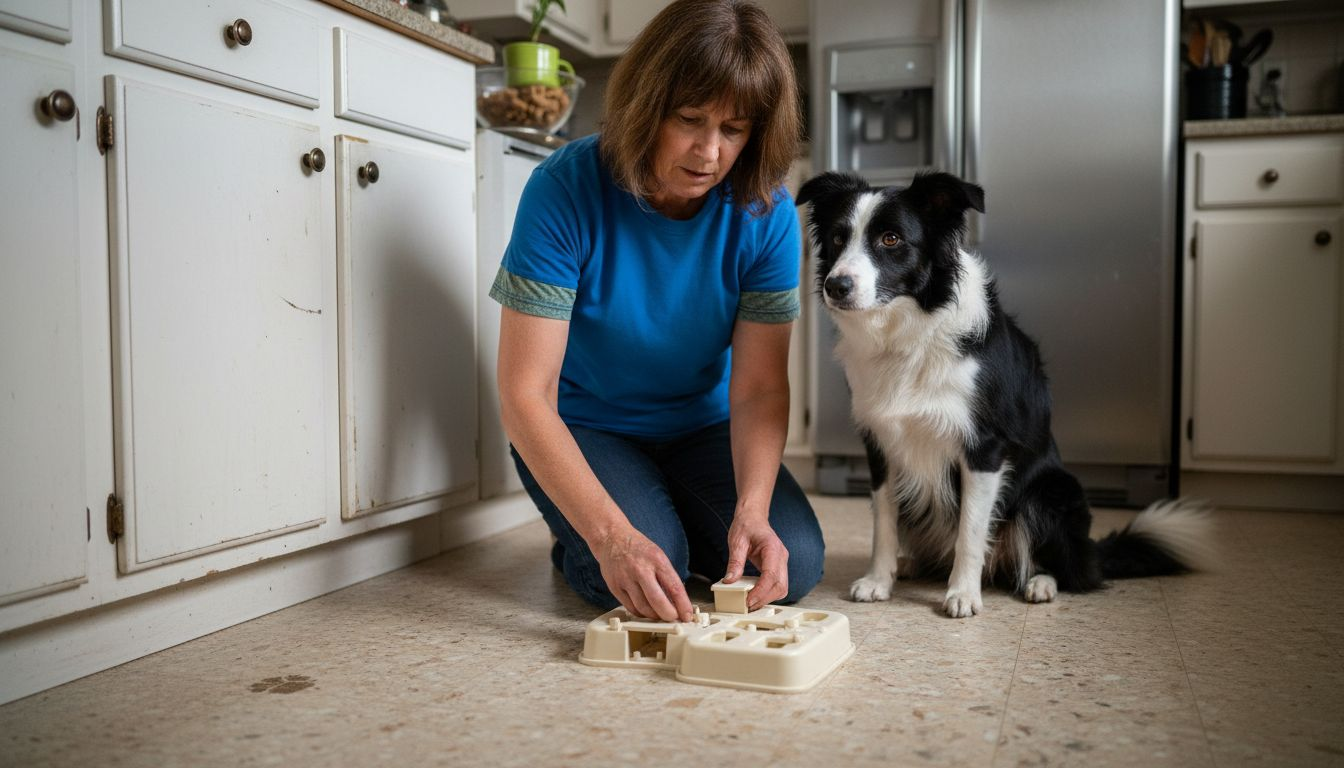
Pro tip: Start with easier puzzle configurations and gradually increase difficulty to build your dog’s confidence and problem-solving skills.
Step 3: Introduce the toy and engage your dog
Successfully introducing a puzzle toy requires patience, strategy, and understanding of your dog’s unique learning style. This critical phase transforms a new object from a potential source of confusion into an exciting mental challenge.
Introducing puzzle toys effectively begins with creating a positive, low-pressure environment that sparks your dog’s natural curiosity. Here are key strategies for a smooth introduction:
- Allow initial exploration without forcing interaction
- Use high-value treats to generate interest
- Demonstrate the toy’s mechanics yourself
- Praise and reward every small interaction
- Keep initial sessions short and fun
Start by letting your dog sniff and investigate the puzzle toy naturally. Show them how it works by manipulating the toy yourself, subtly revealing treats to capture their attention. Your enthusiastic but calm demonstration will help your dog understand this is an enjoyable activity, not a stressful task.
Mental engagement is a journey of discovery, not a test of performance.
Remember that each dog learns differently. Some might dive in immediately, while others need gentle encouragement. Watch your dog’s body language and adjust your approach accordingly. If they seem hesitant, try using more enticing treats or breaking down the puzzle into simpler steps.
Pro tip: Practice the puzzle toy introduction when your dog is slightly hungry and in a calm, familiar environment to maximize their motivation and focus.
Step 4: Monitor your dog’s interaction and adjust difficulty
Successful puzzle toy training is an ongoing process that requires careful observation and adaptive strategies. Your goal is to create a dynamic learning experience that challenges your dog without causing frustration or discouragement.
Monitoring dog puzzle interactions involves watching your dog’s engagement level, emotional state, and problem-solving approach. Here are key strategies for effective monitoring:
- Observe body language closely during play
- Watch for signs of excitement vs. frustration
- Note how quickly your dog solves the puzzle
- Assess interest level in the toy
- Track treat retrieval success rate
Puzzle difficulty should increase gradually. If your dog seems bored or solves the toy too quickly, it is time to introduce more complex challenges. Conversely, if they appear overwhelmed or lose interest, you might need to simplify the puzzle or provide more guidance.
Mental stimulation is about finding the perfect balance between challenge and achievability.
Every dog learns differently. Some will dive into complex puzzles, while others need gentle, incremental progression. Pay attention to your dog’s unique problem-solving style, energy level, and enthusiasm. The key is maintaining their interest while gently expanding their cognitive capabilities.
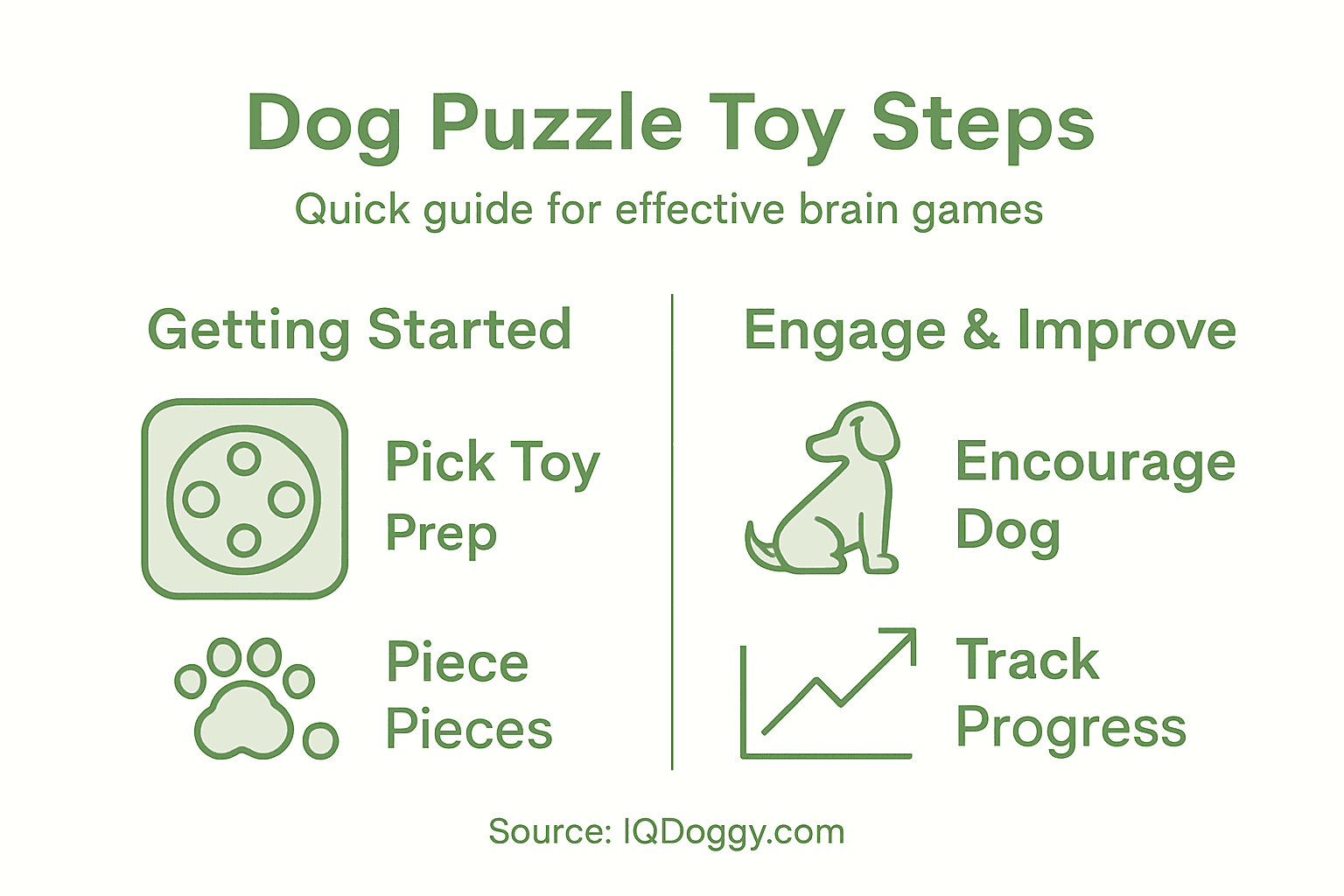
Pro tip: Keep a log of your dog’s puzzle toy progress to track their cognitive development and identify patterns in their learning style.
Step 5: Verify results and reinforce positive experiences
Tracking your dog’s progress with puzzle toys is more than just observing playtime—it is a strategic approach to understanding and enhancing your dog’s cognitive development. Your goal is to create meaningful mental enrichment that grows with your dog’s skills.
Tracking dog enrichment results requires careful observation and systematic evaluation. Here are key indicators of successful puzzle toy engagement:
Here’s a quick reference for tracking enrichment outcomes and behavioral changes:
| Indicator | What to Observe | Potential Impact |
|---|---|---|
| Engagement | Consistent puzzle play | Improved focus |
| Boredom signs | Avoids toy or quickly loses interest | Need for new challenges |
| Confidence | Solves puzzles faster over time | Cognitive growth |
| Behavior | Less destructive actions | Reduced stress |
| Enthusiasm | Increased excitement with puzzle | Higher motivation |
- Monitor behavioral changes in daily activities
- Watch for increased problem-solving confidence
- Note reductions in destructive boredom behaviors
- Observe improvements in overall mental focus
- Track enthusiasm during puzzle play sessions
Positive reinforcement is crucial in maintaining your dog’s interest and motivation. Celebrate small victories by offering extra praise, occasional high-value treats, or brief play sessions immediately after successful puzzle interactions. This approach helps your dog associate mental challenges with positive experiences.
Mental stimulation is a journey of continuous learning and mutual discovery.
Remember that every dog progresses differently. Some will show rapid improvement, while others might take more time to develop their puzzle-solving skills. Patience and consistent, gentle encouragement are key to building your dog’s cognitive confidence and keeping them engaged.
Pro tip: Create a simple progress journal to document your dog’s puzzle toy achievements, helping you track their cognitive growth and adjust strategies accordingly.
Enhance Your Dog’s Mental Fitness with Expert Guidance and Tools
Unlock the full potential of your dog’s brain games by mastering the art of effective puzzle toy use. If you find it challenging to select the right complexity level, prepare puzzles safely, or keep your dog engaged without frustration you are not alone. The article highlights key points like matching toy difficulty to your dog’s skill, monitoring their interaction closely, and reinforcing positive experiences to prevent boredom and build confidence. These steps are crucial for promoting cognitive growth and reducing behavioral issues related to mental understimulation.
At IQDoggy, we specialize in helping dog owners just like you deepen their understanding of mental enrichment techniques and provide science-backed strategies to support your dog’s intelligence and emotional well-being. Explore our detailed guides on puzzle toy selection and brain games, discover expert insights on stress-free introductions, and gain access to premium resources designed to keep your dog motivated and mentally sharp at every stage of life. Start transforming play into meaningful mental activation today by visiting IQDoggy brain games hub and join a community dedicated to your dog’s happiness and lifelong cognitive health.
Frequently Asked Questions
How do I choose the right dog puzzle toy for my dog?
Selecting the right dog puzzle toy involves considering your dog’s size, chewing intensity, and problem-solving abilities. To start, assess your dog’s traits and choose a toy that matches their size and skill level.
What steps should I take to prepare and assemble a dog puzzle toy?
To prepare a dog puzzle toy, inspect all components for potential hazards and ensure that they are securely assembled. Carefully place treats inside the toy, starting with visible spots before making them more challenging as your dog becomes more adept.
How can I introduce a puzzle toy to my dog effectively?
Introduce the puzzle toy by allowing your dog to explore it without pressure, using high-value treats to spark their interest. Demonstrate how it works by revealing treats, which will help your dog understand that the toy is meant to be a fun challenge.
What should I monitor while my dog is interacting with the puzzle toy?
While your dog plays with the puzzle toy, observe their body language and emotional reactions to gauge their excitement or frustration levels. Adjust the puzzle’s difficulty based on how quickly your dog solves it to keep them engaged and mentally stimulated.
How can I track my dog’s progress with puzzle toys?
You can track your dog’s progress by monitoring behavioral changes, such as increased problem-solving confidence and reduced boredom-related behaviors. Keep a simple log of their interactions to identify patterns and adjust the toy’s difficulty accordingly for ongoing mental enrichment.
Leave a Reply